


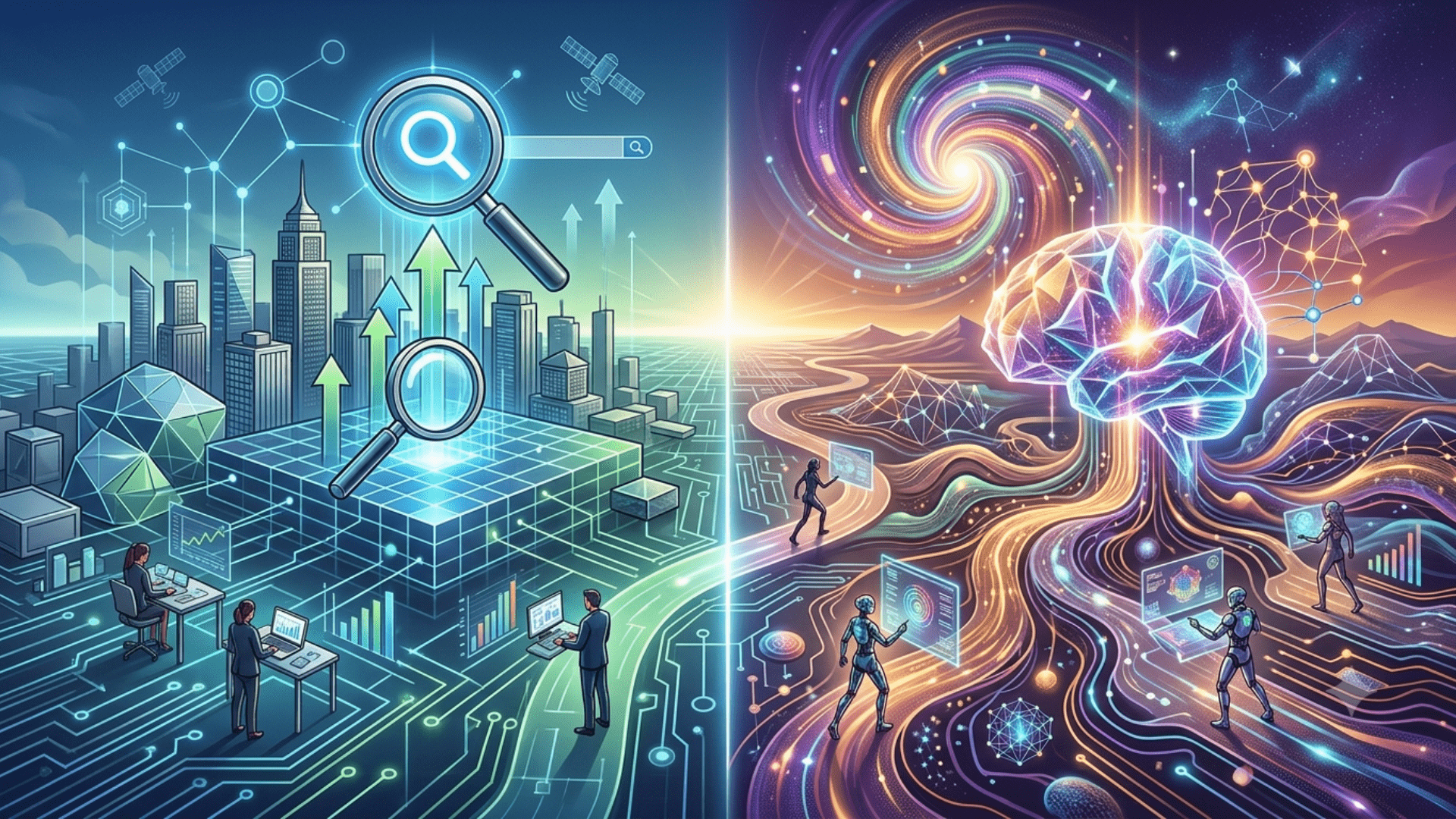
For the past several years, SEO has had one central goal – to gain the top ranking on Google and get the click. However, with the rise of Generative Engine Optimization or GEO, the picture looks very different in 2026.
Users are now asking AI systems to find answers, provide reviews, solve problems, compare products, or carry out research, all without even visiting a website. According to Google, AI Overviews have surpassed 2.5 billion active users per month, while AI Mode is used by over one billion global consumers.
The shift is clear – GEO is fast becoming the new frontier when it comes to digital marketing. But does that mean SEO is being left behind? Not at all.
Let’s take a closer look at Generative Engine Optimization and how brands can best leverage it to drive engagement and growth.
What Is Generative Engine Optimization?
Generative Engine Optimization (GEO) is the process of shaping a brand’s digital presence in a way that enables AI answer engines to understand, trust, cite, and recommend that brand.
Traditional SEO was targeted towards winning a ranked link. GEO is targeted towards winning visibility in AI-generated responses from platforms like Google AI Overviews, Gemini, ChatGPT, Claude, Perplexity, and Microsoft Copilot. This response could be a summarized explanation, a product recommendation, a cited source, or an AI-generated shortlist.
GEO requires more than just focusing on keywords. While generating their summarized response, AI engines check for factors like lucid explanations, structured and consistent data, expert insights, third-party authentication, and content that caters to user intent.
SEO Alone is Not Enough in 2026
According to Gartner, traditional search volume is predicted to decrease by 25% in 2026, as search queries are increasingly being substituted by virtual agents and AI chatbots. McKinsey’s 2025 AI Discovery Survey predicts that by 2028, $750 billion in U.S. revenue is set to flow through AI-powered search. It is evident that GEO is more than a mere content tactic – it’s a revenue-generating strategy.
Both discovery and attribution are changing with the rise in AI search. Just ranking well is no longer a guarantee of high traffic. Pew Research found that Google users who viewed an AI summary clicked a traditional search result in just 8% of visits, compared to 15% of visits without an AI summary. The user may not click if the AI response provides a satisfactory answer, but the brand named in the AI summary still gains visibility and influence.
GEO vs SEO: Competitors or Complements?
In 2026, SEO is far from becoming redundant – in reality, it is the foundation of robust GEO. Factors like crawlability, indexable pages, topical authority, schema markup, backlinks, and technical health are still important. The difference is that AI engines compress the search journey by providing a summary in place of a list of links.
Where SEO focuses on keyword relevance and authority signals, GEO prizes credible statistics, factual density, clear source attribution, entity consistency, expert-backed validation, and machine-readable structure. The best strategy is to treat them as connected disciplines – SEO for discoverability, and GEO for influence within AI-generated responses.
Recent Examples of Successful GEO
A KDD 2024 paper discussing the growth of GEO revealed that it could boost visibility in generative engine responses by up to 40%. Here’s how brands are utilizing GEO to disrupt the way customers discover and engage with them.
- Pinterest: In 2026, the company employed vision-language models and AI agents to create a production-scale GEO framework. Billions of visual assets were turned into search-optimized collections, resulting in 20% organic traffic growth and multi-million monthly active user growth.
- Adobe: In April 2026, Adobe acquired Semrush, stating that AI-powered agents and interfaces are fast becoming primary channels for brand discovery, evaluation, and engagement.
- Retail Case Study (2025): This brand enhanced their content with the addition of use cases, compatibility details and Product, Offer, Review and FAQ schema. Within four months they experienced a 120% growth in AI-driven revenue, with a 693% rise in AI-channel traffic.
- Home Services Case Study: The company ran an AI-first content strategy campaign with structured data and brand mentions. They reported a 458% rise in AI Overview visibility, along with 20% growth in web leads.
How Brands Can Leverage GEO to Drive Engagement
Start by focusing on the most frequent questions customers ask before visiting your site. Then create content to provide the most useful and verifiable answer.
Prioritize these GEO actions:
- Create answer-first sections: FAQs, concise definitions, pros and cons, comparison tables, and “best for” recommendations.
- Include proof: Expert quotes, evidence-backed statistics, product specifications, customer outcomes, citations, dates, and source references.
- Use structured data: Organization, LocalBusiness, Product, Review, HowTo content, FAQ, Article and Video schema where relevant.
- Maintain consistency: Brand entities should be consistent across your website, Google Business Profile, YouTube, directories, LinkedIn, and industry platforms.
- Consolidate third-party authority: Publish authentic research, case studies, surveys, and benchmarks that AI systems will readily pick up and cite.
- Measure “AI share of answer”: Monitor how often your brand is cited, how it is described, which other competitors are featured, brand sentiment, AI referral traffic, and conversions from those sessions.
Conclusion
From “How do we rank for this keyword?” the shift is now towards “How can we become a credible source to answer this query?” As search becomes multimodal, conversational, and decision-driven, companies need to focus on combining robust SEO with well-structured, reliable, and AI-readable content. At DigiDrub, our team of experts is ready with outcome-driven GEO strategies customized to your unique requirements. Reach out to us for a consultation right away.