


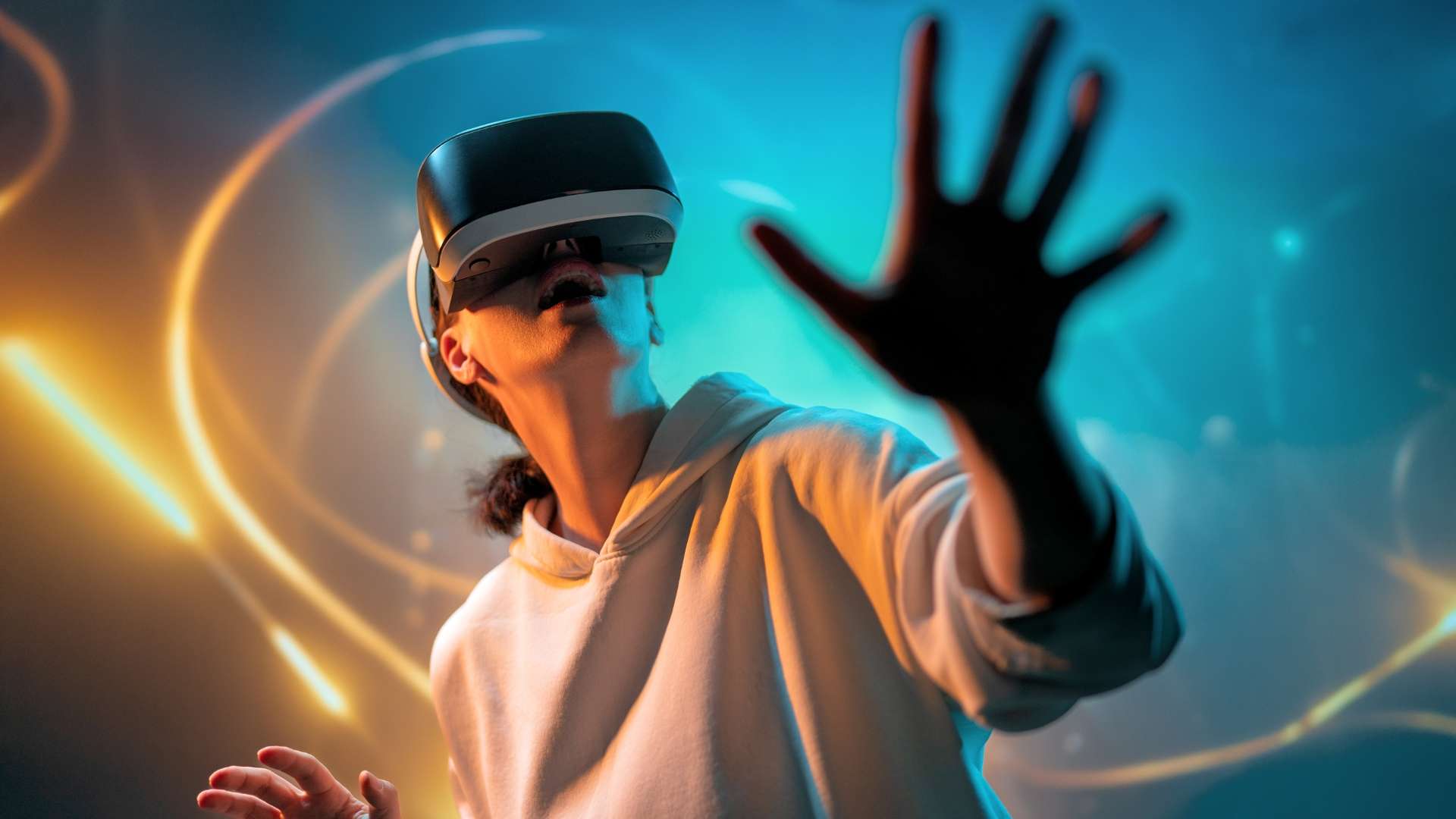
Extended Reality or XR isn’t just a gimmicky gaming demo anymore. In 2026, XR has become an intrinsic business layer across diverse areas ranging from retail and healthcare to education and real estate. Forecasts estimate that the global market for extended reality solutions will reach $346.09 billion in 2026, and will rise to $2.13 trillion by 2034; North America was listed as the largest market in 2025, representing 41.6% of revenue.
The disruptive impact of XR is being harnessed successfully by a number of industries. In this blog, we take a look at 10 industries that are being reshaped by extended reality in 2026.
1. Healthcare: Improved Training, Safer Outcomes
Healthcare is one of the most serious and relevant areas where hospitals and medtech companies are making effective use of XR application development. AR overlays are used for surgical planning, 3D models are making anatomy studies more immersive, and VR is being leveraged for pain therapy, rehabilitation, exposure therapy, and clinical training.
The FDA has a public list of AR/VR medical devices, where an estimate listed 104 entries in 2026, a major boost from 30 in 2022. The key is to focus on patient safety, clinical workflow, and regulatory transparency, rather than futuristic imagery.
2. Retail and Ecommerce: The Rise of Try-Before-You-Buy
In the world of online retail, XR becomes a powerful conversion tool. When it comes to industries like fashion, beauty, eyewear, and home improvement, XR can reduce guesswork around color, size, fit, and context. Brands are using XR for virtual furniture placement, beauty shade matching, eyewear try-ons, fashion previews, and custom product visualization.
According to Shopify, merchants who add 3D and AR content experience a 94% increase in conversions. A best practice is connecting AR to product pages, paid social, email, and retargeting.
3. Education: A Shift From Passive Learning to Immersive Practice
The face of education is changing radically in 2026, and XR is one of the main drivers. By transforming abstract lessons into live experiences, learners are able to solve problems and practice procedures in virtual environments.
This helps schools and universities to significantly enhance comprehension, absorption, and retention, especially in areas like medical learning and experiential science. Arizona State University reported that the use of weekly immersive scenarios, via their Dreamscape Learn VR biology program, has boosted engagement, grades, and STEM retention.
4. Manufacturing: Fixing Problems Before Production
Using extended reality solutions, manufacturing units are able to refine their designs, reduce errors, and train workers on using complex equipment. AR overlays are being increasingly used for assembly guidance, remote expert support, and routine maintenance.
Recently, Dassault Systèmes partnered with Apple to bring industrial 3D software to Vision Pro. This 3DLive app lets engineers collaborate on scientifically accurate 3DLive digital twins and spot access or maintenance issues before equipment is installed on the factory floor.
5. Real Estate: Selling Spaces Before a Site Visit
XR development companies have revolutionized the world of real estate in 2026. Agents and developers can now leverage XR to generate more qualified leads using remote walkthroughs, virtual staging, 3D tours, and new-development previews. These allow buyers to virtually explore a property even before booking an in-person showing.
Matterport research reveals that virtual tours can help homes sell 31% faster. Marketers can effectively use immersive listings to minimize friction, improve engagement, and support retargeting campaigns.
6. Logistics and Warehousing: Hands-Free Productivity
One of XR’s most compelling business cases is in logistics and warehousing, helping to achieve faster and more efficient onboarding with fewer errors. Using enterprise AR/VR solutions, workers can be guided about picking routes and display order information directly in their field of view.
DHL’s AR “vision picking” pilot guided staff with smart-glass overlays, processing more than 20,000 items and 9,000 orders, and reporting a 25% efficiency increase during the picking process. XR helps in the removal of paper lists, handheld scanners, and constant supervisor checks, boosting overall efficiency.
7. Energy and Utilities: Safer Field Operations
More and more energy companies, including oil, gas, renewables, and utilities, are employing AR/VR for maintenance management, remote assistance, and safety simulations. XR is highly effective here as it provides expert guidance about high-risk or remote locations without the necessity of travel.
Shell’s AR Remote Assist allows field workers to get real-time support from experts who can see what they see, offer coaching, draw on the worker’s display, and share documentation. This helps improve safety, lower the carbon footprint, and enhance proficiency across project planning, construction, and operations.
8. Travel and Hospitality: Experience Before Booking
Another popular use of XR application development is in travel and tourism. Hotels and tourist attractions are using VR hotel previews, AR wayfinding, VR destination tours, and immersive storytelling to minimize booking uncertainty and offer their customers a clearer picture of what to expect.
The VR tourism market is estimated at $10.33 billion in 2026 and is expected to reach $37.44 billion by 2030. Travel brands are integrating immersive previews into search, social, and booking funnels, followed by the use of AR on-site for upsells, accessibility, translation, and storytelling.
9. Corporate Training: Faster and Better Learning
In 2026, a significant number of companies are leveraging VR to train their employees in soft skills, customer service, leadership abilities, and safety guidelines. PwC reported that the use of VR helped its trainees to complete their soft-skills training four times faster than classroom learners, and they were 275% more confident when applying what they learned.
XR training can be leveraged across multiple domains, including customer service role-play, DEI and leadership simulations, safety drills, repair walkthroughs, and sales training with realistic customer scenarios.
10. Construction and Architecture: Improved Collaboration on Complex Projects
By linking XR with BIM models, builders, architects, and contractors can now review layouts, spot problems, and guide field teams by walking through a VR building before construction starts. Instead of interpreting flat blueprints, stakeholders can experience the space at full scale and make faster, better-informed decisions without any misunderstandings between owners, engineers, contractors, and designers.
Construction firms should connect XR to practical metrics like fewer change orders, faster approvals, better safety briefings, reduced rework, and reduced site visits overall.
Conclusion
The bottom line is that XR is quietly and efficiently solving business problems that people have long been aware of: training gaps, costly errors, slow approvals, and insufficient digital engagement. In 2026, businesses are using extended reality solutions to ask where they can eliminate friction from the customer or employee experience, and that is where the real success of XR lies. At DigiDrub, we guide you regarding the best use of XR for your brand to help you drive growth and customer satisfaction. Reach out to us to know more.